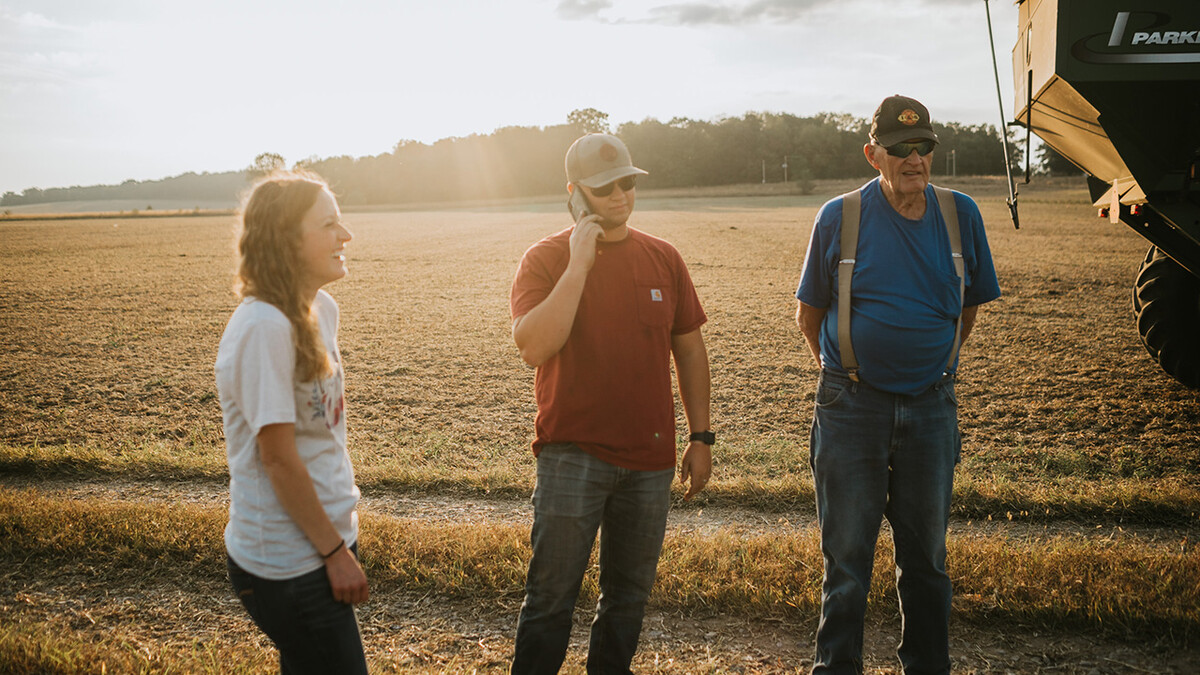
Carter Smith
Town, state you reside in: Shelby, Nebraska
Occupation: senior constituent services and field representative for Congressman Mike Flood's office
Nebraska LEAD Class Number: 42
Tell us a little about yourself — where you’re from and your connection to Nebraska agriculture or natural resources.
I grew up on a row crop farm south of Shelby, Nebraska, raising corn and soybeans, and more recently, seed corn. I attended Nebraska Wesleyan University, where I also played football. I briefly interned at Farm Bureau before taking an internship with Sen. Deb Fischer’s office in Washington, D.C. I returned to Nebraska to work on the family farm and to work for Congressman Mike Flood, focusing on agriculture policy and constituent casework.
What motivated you to apply for the Nebraska LEAD Program?
A smaller number of people each year are directly involved in the agricultural sector which means it's much harder for producers to convey their message to people outside the industry about all the good that we do each and every single day. The NE LEAD program gave me the base knowledge and tools to better convey this message when conversing with people who've, for example, never even been on a farm before.
What’s been the most eye-opening or impactful experience you’ve had through LEAD?
Growing up, agriculture to me was strictly corn, soybeans and later seed corn. I didn't really have exposure to the livestock industry or any other crops. In the NE LEAD program we truly cover every section of the industry ranging from the staples of corn, soybeans and beef but also sugar beets, wheat, swine and chicken production and not to mention the role the NRD's and NPPD play as well.
How has your participation in the Nebraska LEAD Program inspired you to get involved?
Many people don't get involved in politics because of the perceived notion that obtaining the office of an elected official is too insurmountable. While becoming a senator or representative at the federal level is no easy task, the number of ways to get involved at a more local level are limitless. Serving on your local town's city council, NRD or school board or becoming a delegate in Farm Bureau are all ways you can be involved in the community without having to raise large sums of money to run for a federal office.
What advice would you give to someone considering applying to the Nebraska LEAD Program?
Use the NE LEAD program to try and learn something that you don't already know. Everyone in the NE LEAD program is connected to the agricultural industry, but that covers a wide range of topics that can be connected but still inherently separate. If you're a row crop farmer, you're always going to be learning more about that profession because that's your job, it's what you do each and every single day. However, in LEAD you may run across someone who is an expert in cow-calf operations, and you could maybe learn something that would potentially encourage you to enter into that industry.
What do you view as the biggest challenges facing agriculture in Nebraska?
I believe the most critical issue facing agriculture as a whole in the next five to 10 years is the false belief that ag is somehow bad for the environment. Convincing people in the U.S. who aren’t involved in ag that what we do doesn’t harm the environment and, in fact, is actually good for the environment is the most important thing we will have to deal with in the next decade.
Depending on what research article you click on, roughly 10% of the U.S. population works in the ag industry. This doesn’t mean 10% of the U.S. population is directly involved in farming or ranching, just working in the ag sector, such as being an employee at an ethanol plant, for example. Even if we go with the 10% number, that means 90% of the U.S. population (over 300 million people) does not have any direct contact with the ag sector. This is a problem as many of them are misinformed or simply not informed at all.
There are many climate activist groups that try to label ag as “factory farms” and describe how we pollute the environment and have no regard for the land. The reality is that farmers care extensively more about the quality of their farmland than anyone who lives in a major city because for farmers, the land is their livelihood. Without the land, we have nothing. The problem is many people who aren’t directly involved in ag fall victim to believing the climate activists.
The Ag industry needs to do a better job of explaining that ag is not the issue when it comes to climate change. To state my personal bias, I’m not the biggest climate alarmist person. However, it doesn’t matter what I think; what matters is what the other 90% of the population thinks. Farmers and ranchers don’t have a business without the other 90% of the population that ultimately ends up being the end user of their products, even if the 90% doesn’t know it. If we can properly educate the 90% of the population that isn’t involved in ag that farmers and ranchers aren’t bad for the Earth and are actually the saviors of it, demand for our products and general support for the ag sector will increase, which is what everyone wants.
I recently attended a near weeklong biofuels tour where we stopped at corn/soybean farms, ethanol plants, bio-diesel refineries, etc., across Iowa. This tour was for congressional staffers. There were many people like myself from the Midwest such as Iowa, Minnesota and Nebraska who are familiar with ag. Then on the opposing side of the spectrum, there were staffers from major metropolitan areas on both coasts. Many of the staffers from the coasts work for members who list climate change as one of their top priorities.
I found myself trying to convince these staffers to tell their bosses that supporting ethanol and bio/renewable diesel is no different than supporting electric vehicles. You would’ve thought I was working for one of the climate activist groups with how I was talking to these staffers from the coasts. Many of them had no idea that corn and soybeans can power our cars and trucks just as clean and efficiently as electric cars. Even for the staffers who worked for say a New York City representative where there’s not one stalk of corn grown in their whole district, I kept hammering down that if they are truly concerned about the climate crisis, they should support ethanol and bio/renewable diesel production in the same capacity that they support electric vehicles.
Lastly, even the livestock producers can benefit from increased adoption of renewable fuels. If more ethanol and bio/renewable diesel is made, then that also means more dried distillers grains with solubles, and soybean meal will also result from this, leading to a continual supply of low-cost animal feed protein.
In summary, the biggest issue facing ag in the next decade is convincing 90% of the population that ag is the solution, not the problem, to the climate crisis that our opponents tend to believe in religiously and that representatives from all across the country need to specifically support the renewable fuels industry if they want to solve this. Ag utilizing no-till, cover crops, manure, biologicals to reduce fertilizer use etc., are just a few examples of how ag is not bad for the Earth but actually good for it.
What keeps you optimistic about the future of Nebraska agriculture?
The resilience of the producers we have across the state. For many of them, agriculture is not just a profession but a way of life. For Nebraska farmers and ranchers, it's hard for many of them to imagine doing anything else.