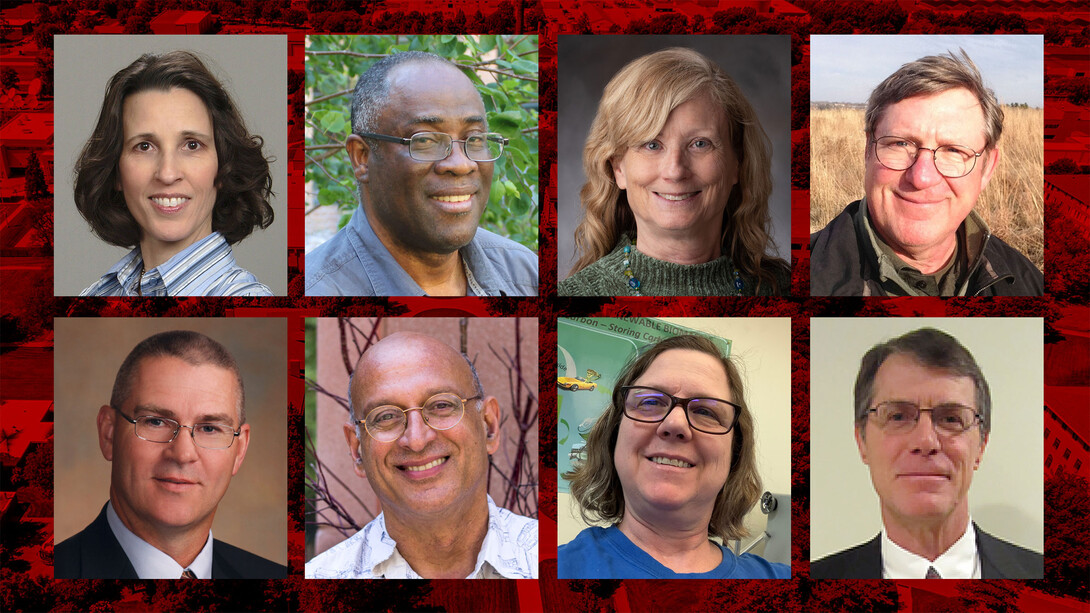
A retirement reception for U.S. Department of Agriculture, USDA Agricultural Research Service and University of Nebraska–Lincoln–affiliated research scientists, adjunct professors and staff will be held from 2–4 p.m. Dec. 19 in the Goodding Learning Center, Plant Sciences Hall, Room 280. Cake and refreshments will be served.
The USDA and the Departments of Agronomy and Horticulture and Plant Pathology will honor Lisa M. Durso, Serge J. Edmé, Deanna Funnell-Harris, Tim Kettler, Rob Mitchell, Gautam Sarath, Susan Siragusa-Ortman and John Toy for their dedication and service.
Lisa M. Durso, USDA research microbiologist and adjunct professor in the Department of Agronomy and Horticulture, is retiring after more than 16 years of service at Nebraska and more than 25 years of expertise investigating the critical agricultural interface of food safety, environmental quality and public health.
Durso is from Buffalo Grove, Illinois. As an undergraduate at Illinois State University, she had a positive research experience with a plant morphologist while earning a bachelor’s degree in biology. The experience inspired Durso to pursue a master’s degree in botany from Miami University in Oxford, Ohio, and to continue in the field. She moved to Nebraska in 1997 to pursue a doctorate in food safety microbiology.
She returned to Nebraska’s East Campus in 2009 after accepting a position in the U.S. Department of Agriculture Agricultural Research Service Agroecosystem Management Research Unit. She was promoted to professor in 2020.
“I have had the good fortune to work with an outstanding group of scientists to support safe and stable food supply systems, address environmental challenges, provide useful information to farmers and policymakers, and mentor the next generation of agricultural professionals,” Durso said.
She led a nationally recognized research program focused on microbial interactions in agricultural environments, antibiotic resistance in soil and water systems, and One Health research approaches in food and crop production. Durso has more than 80 peer-reviewed publications, technical protocols, and book chapters, in addition to numerous technical reports, trade and extension articles, and contributions to white papers, national action plans and policy briefs.
In retirement, Durso said she looks forward to new experiences and giving back to the community. She is eager to have more time and flexibility to visit out-of-state family, start a regular exercise program and take a more active role in professional activities beyond the bench.
Serge J. Edmé, USDA-ARS research geneticist in the Department of Agronomy and Horticulture, is retiring after 10 years of service at Nebraska.
Edmé earned a bachelor’s degree from the School of Agronomy in Haiti, a master’s degree and a doctorate from the University of Florida.
His research focused on genetic parameters to optimize breeding schemes for polyploid species of perennial grasses bred for livestock forages and bioenergy feedstocks. Edmé’s projects included developing germplasm and varieties of perennial grasses that met the needs of bioenergy platforms and forage production systems in the U.S. Great Plains. He also designed better cultivars using selection index theory and retrofit grass cultivars.
Deanna Funnell-Harris, USDA-ARS professor and research plant pathologist in the Department of Plant Pathology, is retiring after 23 years of service at Nebraska and more than 35 years in this field.
Funnell-Harris is from Costa Mesa, California, and became interested in plant pathology as an undergraduate studying natural resources at the University of California, Berkeley, including plants and fungi and their interactions — pathogenic or symbiotic. She went on to earn a doctorate in plant pathology from the University of Arizona.
At Nebraska with the USDA-ARS, Funnell-Harris’ research focused on delineating key aspects of plant-fungal interactions, particularly pathogens that infect grain and other crops. A significant portion of her research demonstrated, for the first time in any crop, that sorghum lines with reduced lignin content did not have increased susceptibility to pathogens and, in some cases, showed increased resistance — challenging widely held assumptions about the role of lignin in plant defense.
She received over $2.6 million in grants from the USDA NIFA and the U.S. Wheat and Barley Scab Initiative to support her research on sorghum and wheat pathogens.
Funnell-Harris served as a mentor for a U.S. Wheat and Barley Scab Initiative-supported graduate student and formally served on 13 other University of Nebraska–Lincoln graduate committees. She served on the editorial boards of two major plant pathology journals, as vice president and president of the North Central Division of the American Phytopathological Society, and as vice chair and chair of two APS committees. She was promoted to professor in 2019.
In retirement, Funnell-Harris looks forward to traveling, volunteering for her favorite causes, and moving back to the drier and warmer Southwest.
Timothy Kettler, a USDA-ARS biological science technician and data specialist and affiliate with the Department of Agronomy and Horticulture, is retiring after 35 years of service at Nebraska.
A native of Lincoln, Kettler grew up with a love for science. He earned a bachelor’s degree in natural science education and a master’s degree in agronomy in soil and water sciences, both from the University of Nebraska–Lincoln.
“Soil science encompasses chemistry, biology and geology,” Kettler said. “After graduation, I was looking for a job in a field that would utilize my degree in science education. Soil science and agronomy were a great fit!”
After finishing his undergraduate degree, he was offered the opportunity to participate in agroecosystem research with USDA-ARS scientists. While employed by Nebraska under a cooperative agreement, he supported USDA-ARS field and laboratory studies in soil nitrogen cycling and biochemistry with the late John Doran and many visiting international scientists and graduate students.
In the Fall of 2000, Kettler accepted a position as lecturer in the agronomy department, teaching 153 Soil Resources in collaboration with Professors Martha Mamo and Dennis McCallister. He continued teaching Soil 153 through 2017 and was promoted to associate professor of practice in 2009. During this time, he coordinated the annual FFA Agronomy Career Development Event and acted as an academic adviser for agronomy students and the agronomy club.
In 2019, he rejoined the USDA-ARS Agroecosystem Management Research Unit as a biological science laboratory technician with the soils and crops group, and in 2021 became the agroecosystem data specialist and long-term agroecosystem research liaison for the unit.
In retirement, Kettler plans to travel to see the world’s many natural wonders, enjoy time with family and friends, hike, bike, garden and golf.
Rob Mitchell, USDA research agronomist and adjunct professor in the Department of Agronomy and Horticulture, is retiring after 23 years of service at Nebraska.
Mitchell is from Elm Creek, Nebraska, where he grew up hunting, fishing and spending every opportunity outdoors. His interest in plants and science began on his family’s land, where generations of his paternal family hunted the same stretch of the Platte River for 150 years. His grandfather farmed in Dawson County and often talked about how native grasses and smooth bromegrass played a significant role in pastures after the droughts of the 1930s.
After beginning his studies at Kearney State College and later transferring to Nebraska Wesleyan University, Mitchell spent time away from school before enrolling at the University of Nebraska–Lincoln, where he said it felt like home.
“Learning from and interacting with the likes of Jim Stubbendieck, Steve Waller, [the late] Lowell Moser, Bruce Anderson, Ken Vogel, Bob Masters, Ken Moore and Martin Massengale was an incredible blessing,” Mitchell said.
He received a bachelor’s degree in natural resource wildlife, a master’s degree and a doctorate in agronomy in range and forage, all from Nebraska.
When he returned to campus in 2002, he focused on perennial grasses, bioenergy, grassland management, growth, development and ecology for the USDA and the university. He was promoted to professor in 2010.
“I was honored to work with true giants in agricultural research and am thankful for the opportunities provided here,” Mitchell said.
In retirement, Mitchell plans to spend time with his wife, Michele; build and remodel homes; do woodworking; invest in his five grandsons; spend time with family; serve on the board of a Christian camp and serve people in any way he can.
Gautam Sarath, USDA-ARS research molecular biologist, biochemist and adjunct professor in the Department of Agronomy and Horticulture, is retiring after 41 years of service to Nebraska.
Sarath became interested in plants and science because he liked gardening. He earned a Bachelor of Science and Master of Science in botany from the University of Delhi, India, and a doctorate in plant physiology and biochemistry from the University of California, Davis.
Sarath started as a postdoc in agricultural biochemistry, working on soybean nodulation at the University of Nebraska–Lincoln. He later joined as a non-tenured track faculty member, managing the Protein Core Facility for the Center for Biotechnology and the Department of Biochemistry.
In 2003, he joined the USDA-ARS to work on switchgrass and biofuels research and was appointed as an adjunct professor of the agronomy and horticulture and entomology departments.
“These were the best years of my professional life,” Sarath said.
In retirement, Sarath looks forward to spending time with family and friends, taking extra afternoon naps and whatever life has left to offer.
Susan K. Siragusa Ortman, a USDA agricultural science research technician and affiliate with the Department of Agronomy and Horticulture, is retiring after more than 25 years of service at Nebraska.
Originally from Omaha, Nebraska, Siragusa Ortman was interested in the environment, so she studied soil science in college, earning a Bachelor of Science from the University of Arizona.
As a lab technician for the USDA at Nebraska, Siragusa Ortman worked in the Soil Quality Lab and conducted field work with soil scientists Brian Wienhold, the late John Doran, and Kettler. She ran plant and soil samples on the Thermo Scientific Flash Elemental Analyzer to simultaneously measure the total carbon and total nitrogen content in soil, and she did greenhouse gas work with Virginia Jin.
In retirement, Siragusa Ortman plans to spend time on crafts and home projects, time with family and pets, maybe volunteer with animals or causes she cares about, and travel with her husband.
John J. Toy, USDA-ARS agronomist and adjunct with the Department of Agronomy and Horticulture, is retiring after 49 years of service at Nebraska.
Toy is originally from Fort Wayne, Indiana. His grandparents and uncle farmed, so he was interested in growing plants and gravitated toward agronomy when he started college at the University of Nebraska–Lincoln, where he earned a Bachelor of Science.
“I was blessed to take Dr. [David] McGill’s genetics class and was very active in the agronomy club,” Toy said.
Rick Waldren, Jim Schepers and late Dale Flowerday, all agronomy professors in the department, were the agronomy club advisers at that time. They encouraged Toy to apply for a graduate student assistantship with the late Francis Haskins and the late Herman Gorz, both research geneticists at the university at the time. So, he pursued a master’s degree in agronomy.
He said this led him to a lifelong career with the university and the USDA-ARS. He spent the bulk of his career working with Haskins, Gorz, Jeffrey Pedersen, associate professor emeritus, and Scott Sattler, USDA research molecular biologist.
“I have been fortunate to have wonderful mentors in my career,” Toy said. “I was given considerable latitude to make decisions and determine priorities. I was also blessed with outstanding co-workers and student assistants to accomplish the work.”
He was involved in the development of over 200 sorghum populations, genetic stocks and elite lines. He was awarded the USDA-ARS agency-wide Scientific Support Award in 2015 for the development of high-impact waxy grain sorghum germplasm.
In retirement, Toy said he plans to spend time with family, travel, attend Husker sports and Detroit Tiger baseball games, garden, fish, golf and volunteer for various endeavors.