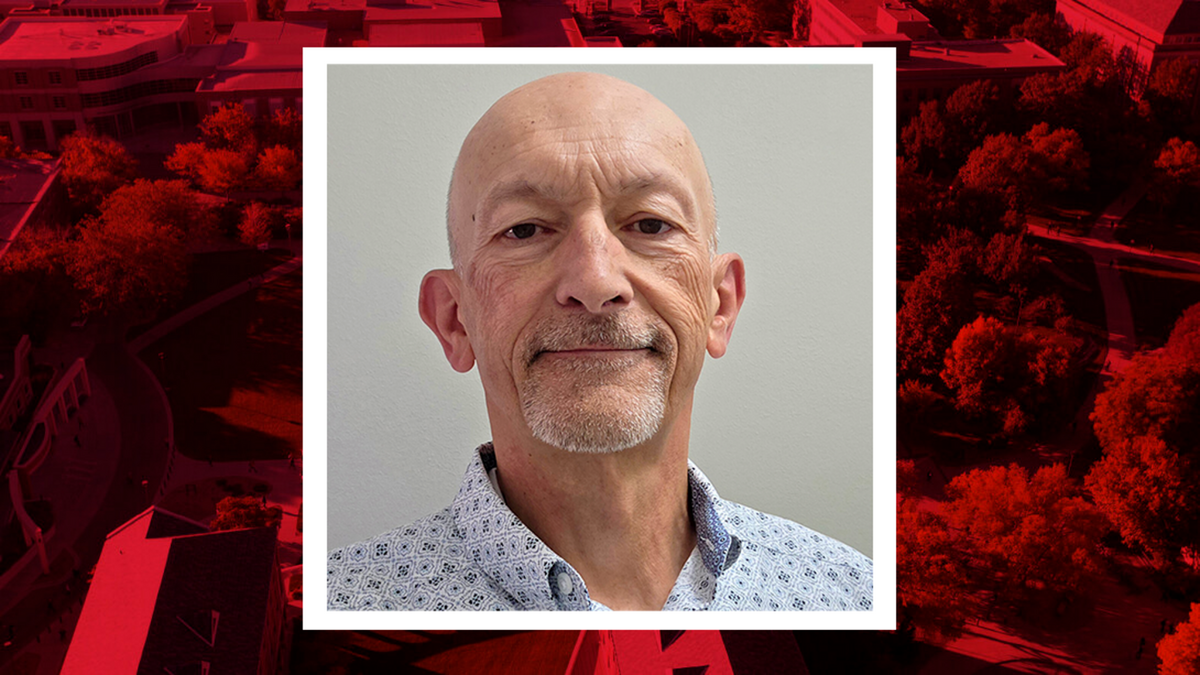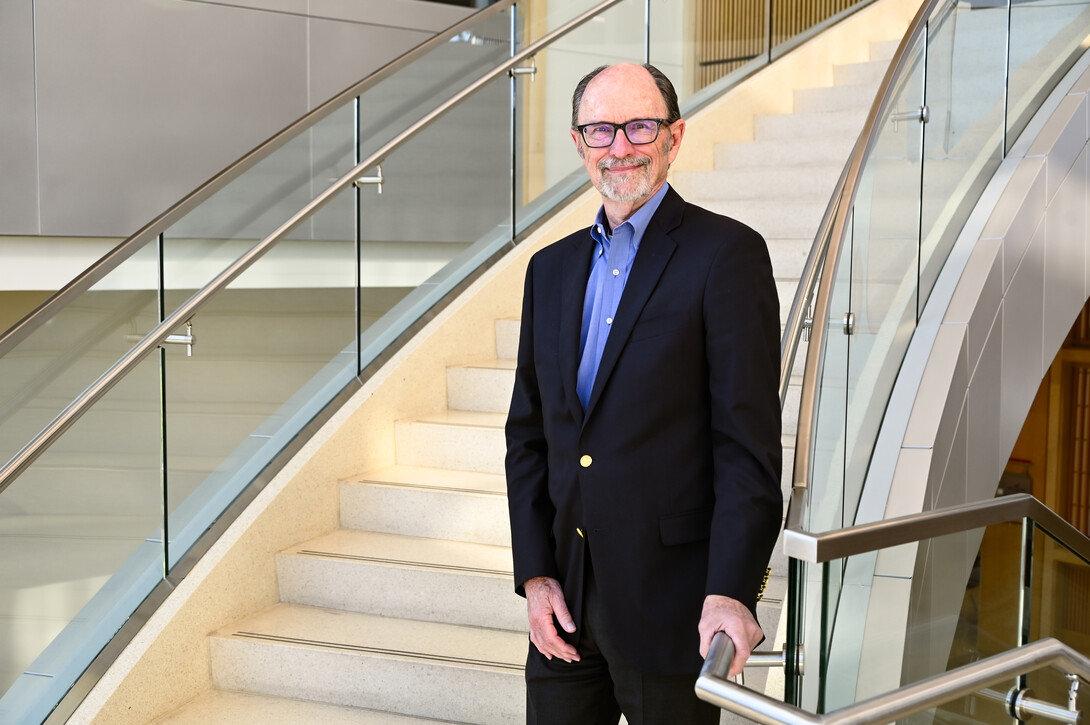
For 35 years, John E. Anderson, Baird Family Professor of Economics and executive director of the Central Plains Federal Statistical Research Data Center, helped elevate the reputation of the University of Nebraska–Lincoln through his research and advising in public finance, fiscal reform and tax policy.
He retired May 18, leaving a legacy carried forward by generations of students he taught and mentored who now work all over the world.
"John’s impact on the College of Business and the university is immeasurable," said Kathy Farrell, James Jr. and Susan Stuart Endowed Dean of the College of Business. "He authored more than 100 scholarly publications and co-authored the widely used textbook 'Public Finance: Theory and Policy.' Supported by the National Science Foundation and multiple federal agencies, his research informed leaders across the nation, as well as fiscal and education reforms across Europe and Asia. Beyond all of his accomplishments, John has been a trusted colleague and leader who strengthened our community, and we wish him all the best in retirement.”
Anderson’s path to Nebraska began in 1990 with an interview process unlike most faculty candidates experience. Along with the traditional research seminar, he was also asked to give a second presentation to business leaders and state legislators on public policy at the Nebraska Club in Lincoln.
“Despite a successful interview visit, I was told budget constraints would delay the hire,” Anderson said. “When I agreed to come to Nebraska a year later, then-department chair Craig MacPhee stayed in close contact to make sure everything moved forward. So, before I even taught my first class at the university, I actually appeared before a legislative committee in the Nebraska Unicameral.”
Throughout his career, Anderson advised governors, legislatures and agencies across the United States. He also credits MacPhee with sending him on a trip to Russia shortly after the collapse of the Soviet Union in the 1990s.
"Craig was an important mentor and helped start my extensive international advising career with that trip," Anderson said. "My early years were marked by progress in research and publications along with professional development and recognition in the field of public finance. The research support and recognition provided throughout the college was extremely helpful."
Anderson served as a technical adviser on U.S. Agency for International Development fiscal reform projects in Moldova, Montenegro and Macedonia. He also taught at and helped revitalize the curriculum at universities in Bulgaria, China, Mongolia, Russia, Taiwan and Tajikistan.
He held multiple leadership positions at the College of Business, including department chair, director of graduate programs and associate dean for research and graduate programs.
"While working as the chair of the Department of Economics, I received a call from the President’s Council of Economic Advisers asking me to serve as a senior adviser in public finance. When I told then-Dean Cynthia Milligan, she said, ‘Yes, you must do it,’” Anderson said.
After his time in Washington, D.C., in 2005-06, Milligan recruited him back to Nebraska to serve as associate dean. When she later retired, Anderson became interim dean and began researching differential tuition, a slightly higher tuition rate for business courses to support the high-quality education and career preparation that sets students apart.
“When Donde Plowman arrived as dean, I told her the best thing I could do for her was to disappear and let her take over with a free hand,” Anderson said. “Instead, she asked me to serve as associate dean to assure continuity.’”
Plowman, who was new as dean, new to the university and new to Nebraska, said she asked John, who "was such a truly good person and wanted the best for the college" to help get her started.
"John offered me sage advice and he and I, together began the transformation of that college. The springboard to that was new resources from differential tuition," Plowman said. "Before I arrived John had begun persuading upper administration of the benefits of such an increase in revenues for the college, and once I arrived in Lincoln, we had those resources in hand. We began hiring new faculty and staff and adding programs that enabled the college to grow. I will always be indebted to John and I hope he enjoys every day of his much deserved retirement."
The College of Business was the first at the university to implement differential tuition. The timing aligned with Nebraska joining the Big Ten Conference in 2011.
“Differential tuition combined with the arrival of a new dean and Nebraska’s move to the Big Ten marked a pivotal period for the university and the college,” Anderson said.
In 2014, Anderson helped establish the Central Plains Federal Statistical Research Data Center with funding from the National Science Foundation and served as the executive director. The first to serve the Central Plains region, the center provided qualified faculty and graduate student researchers with access to restricted datasets maintained by the U.S. Census Bureau and other federal agencies. Three years later, he helped start the Yeutter Institute for International Trade to connect faculty and students in business, law, economics and agriculture studying the global economy.
“Those two entities are key to advancing the research profile of Nebraska and giving our students training and opportunities otherwise not available,” Anderson said.
He added that the changes also helped elevate Nebraska’s reputation and strengthen recruitment of faculty and students.
"We have a group of faculty, both tenure-track and professors of practice, who are exceptional right now,” Anderson said. “One of our recent hires was told by his advisor at Wisconsin that the Nebraska Department of Economics is the up-and-coming department in the Big Ten.”
Despite his many advising and leadership positions, Anderson said working directly with graduate students remains the most rewarding part of his career.
“I have loved the opportunity to train graduate students, co-author with them, help prepare them for the job market and then follow them as they develop their own successful careers,” he said. “I have former Ph.D. students who are professors all around the world, and that is wonderfully gratifying.”
In retirement, Anderson plans to spend more time riding his gravel bike and visiting family, especially his 15 grandchildren, who live across the country from Boston to Seattle.
“I viewed my vocation as a calling, not just a job,” Anderson said. "I tried to work heartily, if only imperfectly."