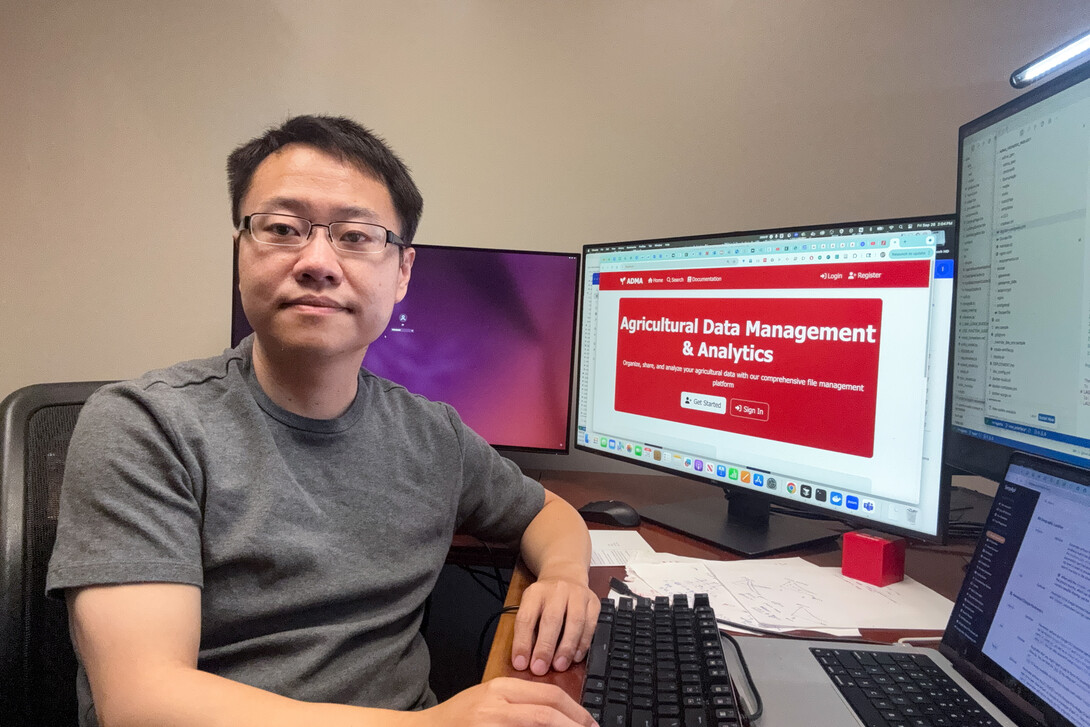
An agriculture data management platform created by University of Nebraska–Lincoln scientists could modernize scientific data management. The platform, Agricultural Data Management and Analytics (ADMA), uses artificial intelligence to understand, organize and coordinate data. Researchers developing the platform said they intend it to allow individuals to better manage and analyze data for research and land management.
Yu Pan, the project lead and research assistant professor in Biological Systems Engineering said ADMA is novel in several ways, including its ability to manage data by geographic location.
“ADMA incorporates data storage capability with GIS’s data processing power, which is not seen in mainstream agriculture science or scientific data management systems now,” he said.
ADMA was introduced in 2023 as a first-of-its-kind platform responding to three major challenges plaguing modern-day researchers:
- Massive amounts of agriculture data
- Incompatible formats
- Costs of moving data from place to place for analysis
More data is beneficial overall, but too much data can become difficult to organize and analyze. This creates what scientists call “data silos” in which the sheer volume, file size and differences in formatting pose a challenge to manually locate, analyze and visualize data, meaning searches are becoming increasingly less effective, especially with the rising number of sensors and other devices that provide constant streams to scientists, even in real time.
In 2024, the team automated the platform by incorporating large language models, like ChatGPT, to develop ADMA Copilot. No longer would experts need to search, navigate or manipulate data manually. Instead, ADMA Copilot could execute those tasks when asked, providing a written answer, a table, a plot or a download of the data.
“We can imagine ADMA Copilot as an intelligent layer added on top of ADMA, which can understand a user’s instructions in their natural language,” Pan said.
Tala Awada, professor in the School of Natural Resources and associate dean in the Agricultural Research Division, said, “It allows us to bring data from different formats and environments to answer questions that would be difficult otherwise.”
A major benefit of the platform, according to the researchers, is that it incorporates Natural Language Processing to search across multiple types of data. This gives researchers the unprecedented ability to search for relevant information in looser terms and links relevant results automatically, something that otherwise takes time and experience to do efficiently.
Hongfeng Yu, professor at the School of Computing and director of the Holland Computing Center, said ADMA could help users get the most out of available data, both saving time for experts and lowering the bar for entry to those not as familiar with data science tools.
“It can significantly reduce barriers for human beings in accessing data,” he said. “Users without the same high level of training or educational background can access more information.”
An advantage of this platform, Yu said, is that the entire process and data are transparently accessible to users, so they can verify the validity of the data and avoid hallucinations, or mis-information, that are prevelant in some AIs.
Developed for use on university projects such as its Long-Term Agroecosystem Research project and Nitrogen Research for Agriculture Transformation, ADMA follows the FAIR computer science principles: findable, accessible, interoperable and reusable.
Through the platform, data scientists have tried to break down data silos and promote collaboration among researchers, policymakers and industry stakeholders. Yu said efforts like this are not possible in a single department.
“The success of this project would not be possible without interdisciplinary collaboration,” he said. “The scientists brought extensive experience in agricultural data, and people like Joe Luck [professor in the Biological Systems Engineering Department], for example, have a strong connection to the state’s farmers.”
Pan said as the project is further developed, its role at the university is set to expand. It was tested using Google Drive, but it will also be compatible with existing cloud storage services like OneDrive, Google Cloud, Amazon AWS or Dropbox.
“They are still in the early phase of deployment and haven’t hosted large volumes of agriculture data so far,” he said. “We can expect it will become the main data infrastructure for [the Eastern Nebraska Research, Extension and Education Center] in the coming year to store the weather data and farm management data from John Deere.”
Two articles detailing ADMA are available to read online:
- Transforming agriculture with intelligent data management and insights
- Building Multi-Agent Copilot towards Autonomous Agricultural Data Management and Analysis
This project started with an investment from the Nebraska Research Initiative led by the Agricultural Research Division and the Holland Computing Center. The project is presently funded by the Partnership for Data Innovation of the USDA Agricultural Research Service.