Ranchers in a University of Nebraska–Lincoln study said the Conservation Reserve Program (CRP) could be modernized and improved using regenerative ranching practices.
David Sandahl, the master’s student from the School of Natural Resources who conducted the study over the past three years, interviewed 24 ranchers in Montana, North Dakota and South Dakota. Most of the ranchers also farmed, producing forage for their cattle. All had either taken part in a form of CRP, were still enrolled or had close family or friends enrolled.
“Nearly all of them seem to be moving away from it, in favor of their own set of practices because they feel like, although CRP may have started with good intentions and had good environmental intentions, now it doesn't quite compare with how regenerative ranching can better benefit not only their operations but the general landscape around them,” Sandahl said.
Since the 1950s, CRP, formerly known as the Soil Bank Program, has contracted with farmers and ranchers to set aside land to benefit wildlife, control erosion and improve water quality. CRP issues 10- or 15-year contracts, but many of the ranchers Sandahl spoke with anonymously said the program was too restrictive.
As an example, when a problem like invasive species appeared on CRP land, ranchers felt the program hindered them in addressing the problem.
“When push comes to shove, these ranchers are under the impression that with CRP, they can't adapt in the ways that they want to, especially in not necessarily a day-to-day thing but more of a year-to-year,” Sandahl said. “When they look at a 10- or 15-year contract, they are like, ‘I don't know why I would ever enter that, because I don't know what I'm going to be doing in 10 years in my own life, let alone on my operation, and so, I need to have all my options in order to best protect the landscape.’”
Several of the ranchers told Sandahl regenerative ranching allowed them to adapt better to change on their ranches. They discussed this style of ranching mainly as adaptive management using rotational grazing, which allows land to recover for a year with natural inputs from manure and urine. It also could include using cover crops, diversified forage and minimal tillage or synthetic inputs. For a problem like invasive species, a regenerative rancher could disc the land and replant with native seeds.
Sandahl noted that ranchers who lived near publicly accessible areas like rivers, lakes or national or state parks disfavored CRP and, instead, favored practices they felt aligned better with protecting or conserving wildlife.
In a related study Sandahl conducted with these ranchers on the effect of regenerative ranching on wildlife, the ranchers reported seeing more wildlife on their land with it than with conventional ranching.
Sandahl had originally started his master’s project to study the use of prescribed burns, but as he spoke with ranchers, the project morphed into a project focused on regenerative ranching and bridging the gap between ranchers and government agents or scientists.
“David’s work really highlights how much insight we gain when we let ranchers steer the conversation,” said Gwendwr Meredith, Sandahl’s advisor and an assistant professor in the School of Natural Resources. “He followed the science where it led, and in doing so, he captured a set of perspectives that are essential for improving conservation programs across the Great Plains."
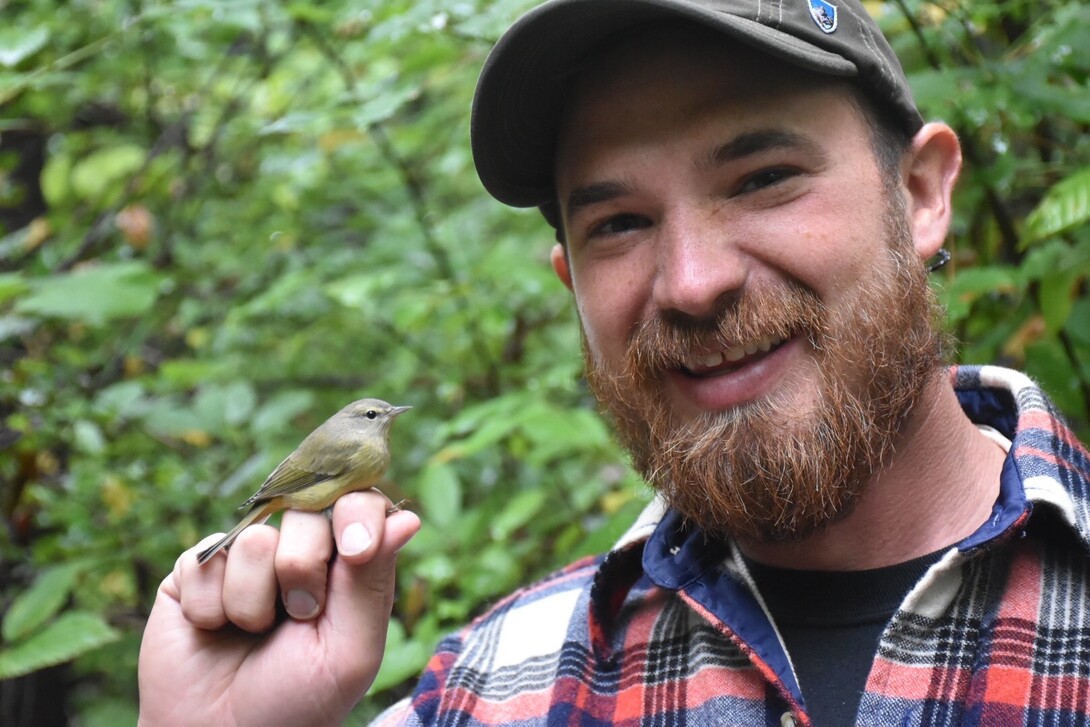
As a scientist and an avian ecologist, Sandahl said he did not always agree with the ranchers he interviewed. He came from a background outside agriculture, having grown up in Northern Michigan with his father, an environmental scientist.
In the past years, he has carried out bird surveys across the Great Plains while working for the Bird Conservancy of the Rockies in Fort Collins, Colo. He met ranchers when he was working on the surveys and sought permission to go on private land. He said he saw a gap between ranchers and scientists or government agents and wanted to bridge it by finding common ground so they could work on problems with their combined knowledge sets.
“A lot of this inspiration for this research came from recognizing, through years of research, the gap that does exist and how I think ranchers tend to get a bad rap for, like, ‘Oh, they're the ones destroying the earth and contributing to climate change,’ and I'm here like, ‘No, I think that they're here to help us, and if we quit demonizing them and work together with them, we can create a better future,’” Sandahl said.
His study used more qualitative research than quantitative, relying on what the ranchers said to convey their feelings and experiences.
“Qualitative research like this is crucial for understanding why conservation programs succeed or fail on the ground,” Meredith said. “David documented not just opinions, but patterns in how people experience these policies. That’s the kind of knowledge we need if we want programs like CRP to truly work for rural communities.”
Sandahl said he felt the research was an important contribution to science in this area.
“Scientists like me, researchers, we need to be, in my opinion, elevating these voices and bringing them into the fold of research,” he said.
Sandahl said he hopes to publish his findings in a scientific journal and would like to continue working in the Great Plains in the human dimensions part of wildlife conservation.


