The University of Nebraska–Lincoln’s Testing Ag Performance Solutions (TAPS) program celebrated its ninth successful year in January with an awards banquet that recognized the top achievers in farm management competitions across the state.
Created in 2017 by Nebraska Extension educators and faculty, TAPS connects producers with industry professionals, offering a platform to test and showcase farm management strategies and technologies in a low-risk environment, while fostering collaboration among farmers, the university and ag industry professionals.
The banquet was a night of interaction and celebration of the six 2025 competitions in three locations across the state:
- Irrigated Sprinkler Corn and Continuous Corn competitions at the West Central Research, Extension, and Education Center in North Platte
- Food Grade Corn competition sponsored by Bayer Crop Science at the Water Utilization Learning Center in Gothenburg
- Irrigated Soybean and N-Source Corn and Irrigated Corn competitions at the Eastern Nebraska Research, Extension, and Education Center near Mead
Participants made several input and management decisions during the growing season, which were implemented alongside those of their competitors in the same field. These decisions differed for each competition, but included things such as crop insurance, hybrid/variety and seeding rate, nitrogen timing and amount, bioactive nutrition products, irrigation timing and amount, insecticide, fungicide, cover crop termination, micronutrient applications and, lastly, marketing of their crop.
Each competition featured unique award categories, including Greatest Grain Yield, Highest Input Use Efficiency, and Most Profitable. Each award came with a cash prize of up to $1,500, plus a plaque, an oversized check, and personalized TAPS apparel for first-time winners.
WCREEC Irrigated Corn Winners
- Most Profitable, Greatest Grain Yield: Sam McCord and Jeff Landon (Alma)
- Highest Input Use Efficiency: Brandon Rimpley, Ron Robison, Brent Stroebel and Adrian Stroebel (Alma)
WCREEC Continuous Corn Winners
- Most Profitable: Jamey Balthazor and Dan Fitts (Scottsbluff)
- Highest Input Use Efficiency: Rattlesnake Boys — Kevin Harsch, Amy Harsch, Jeremy Gewecke and Jay Johnson (Woodriver)
- Greatest Grain Yield: Lorn Dizmang (Moorefield)
Food Grade Corn Winners
- Most Profitable, Highest Input Use Efficiency, Greatest Grain Yield: Matt Dalrymple (Gothenburg)
ENREEC Soybean Winners
- Most Profitable, Highest Input Use Efficiency, Greatest Grain Yield: Kenny Reinke (Neligh)
ENREEC Irrigated Corn Winners
- Most Profitable: Nebraska Department of Water Energy and Environment – Stefan Remund, Rachael Whitehair, Adele Phillips, Andy Pedley, Avery Dresser, Lori Arthur, Noah Hovorka, Jessica Russell, Daniel Ross, Katie Hickle, Sam Fleagle, Lori Arthur, Ryan Kelly (Lincoln)
- Highest Input Use Efficiency: Lauren Benoit, Katie McFarlane, Gabrielle Croft (Tavistock, Ontario, Canada)
- Greatest Grain Yield: Dave Nelson, Josh Reed, Chad Guthrie, Justin Trompke, Lane Schoff, Cole Guthrie (Holdrege)
ENREEC N-Source Corn Winners
- Most Profitable, Highest Input Use Efficiency: Nitrogen Eraser — Curtis Scheele, Carrie Putnam, Pat Nott (Holdrege)
- Greatest Grain Yield: Brandon Andrews (Cambridge)
Also recognized for their dedicated service in developing UNL-TAPS and the Virtual TAPS Program was Matt Stockton.
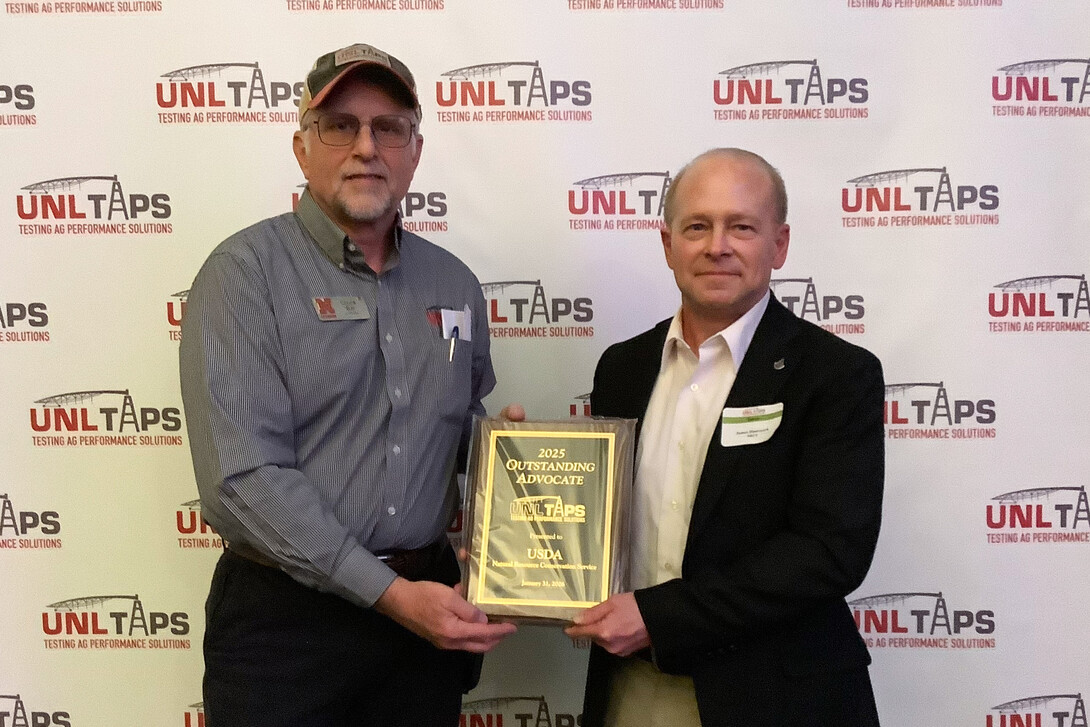
The last recognition presented was the Outstanding TAPS Advocate, which honors an organization, person, or business that goes above and beyond in supporting the UNL-TAPS program. This year, the recipient was the USDA Natural Resource Conservation Service. Since the inception of the TAPS program, Natural Resource Conservation Service has not only provided financial support, but has also been instrumental in advancing the program’s mission.
The full 2025 TAPS competition report can be found at taps.unl.edu and click on Media Library.
TAPS would like to express its gratitude to the generous sponsors, dedicated supporters, and passionate participants whose contributions have been instrumental in driving the continued success and growth of the program.
To get involved or learn more about TAPS, contact taps@unl.edu visit taps.unl.edu