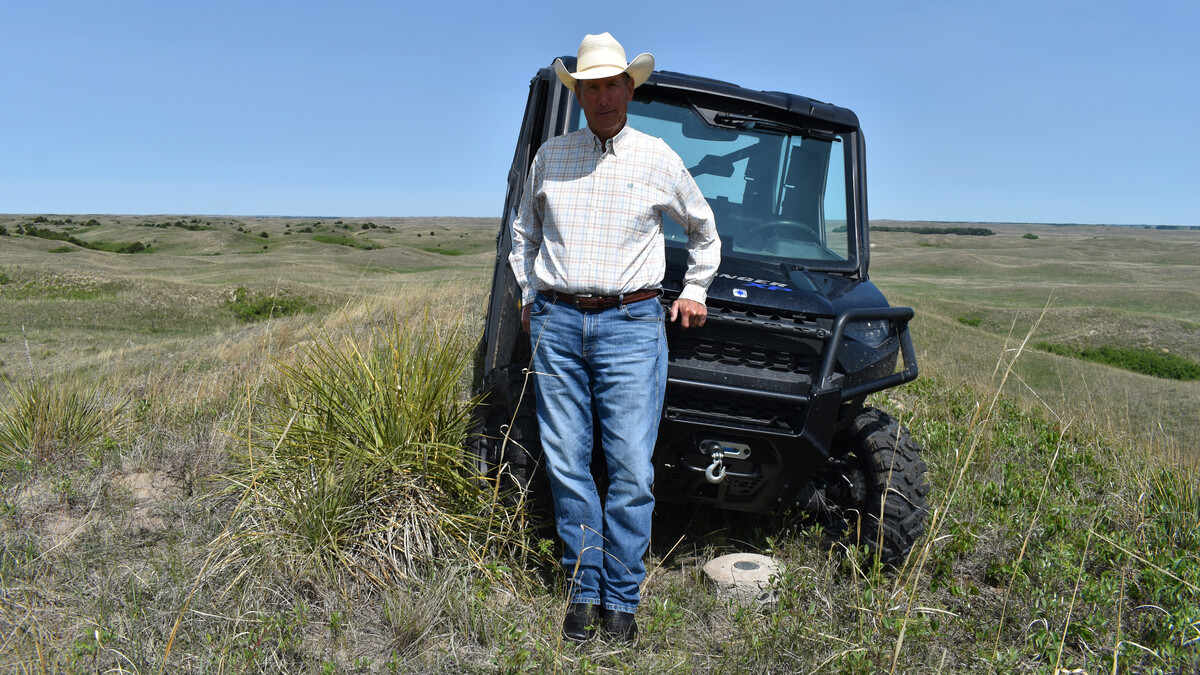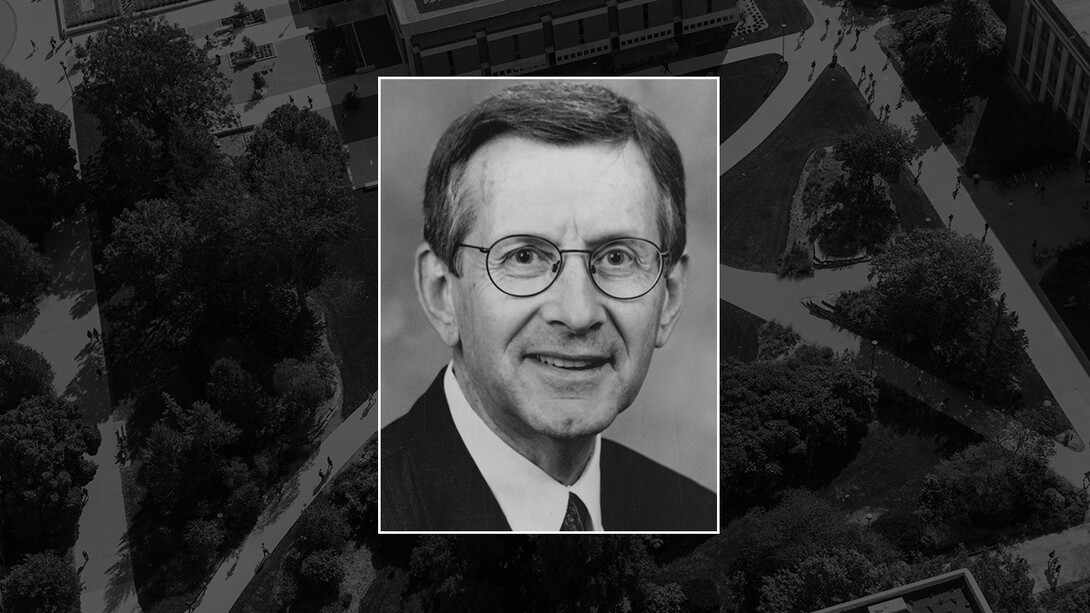
Irvin T. Omtvedt, the fourth vice chancellor of the Institute of Agriculture and Natural Resources, praised for his strategic vision and effective leadership, died April 6 in Lincoln at age 90.
Omtvedt, who retired in June 2000 after a 25-year career at the University of Nebraska–Lincoln, including 12 years as vice chancellor and vice president, championed the development of IANR’s first strategic plan, and promoted collaboration between City Campus and East Campus to create the George W. Beadle Center. Construction of the Animal Science Complex proceeded under his leadership as he built consensus on the structure’s design and functions.
Born at Rice Lake, Wisconsin, in 1935 and raised on a dairy farm in rural Wisconsin, Omtvedt was a first-generation college student who paid his way through the University of Wisconsin–Madison with revenues from his livestock proceeds and dreamed of becoming an animal science professor. In the decades that followed, his professional career brought him national recognition as a swine geneticist and university administrator, including service as president of the American Society of Animal Science, and chair of the animal health and veterinary medicine panel for the National Academy of Sciences.
In Nebraska, the honors included induction in 1997 in the Nebraska Hall of Agricultural Achievements and recognition as a notably consequential leader for IANR and Nebraska agriculture.
“Irv exemplified what it means to lead with purpose,” said Tiffany Heng-Moss, Harlan IANR Vice Chancellor and vice president for agriculture and natural resources for the University of Nebraska System. “As a leader, colleague and mentor, he set a standard of service that strengthened the university and left a lasting legacy for Nebraska agriculture. He will be greatly missed, but his influence will continue to guide the university and Nebraska agriculture for generations.”
Omtvedt joined UNL in 1975 as head of the Department of Animal Science and in 1983 was named dean of the Agricultural Research Division. In 1988, he began service as IANR vice chancellor. He also served as interim senior vice chancellor for academic affairs (1996-97) and as vice chancellor for extended education (1997-99).
In 1992, he became the first IANR vice chancellor to also hold the position of vice president for agriculture and natural resources for the University of Nebraska System, a reform the Board of Regents adopted to better secure ag and natural resources focused input to the highest levels of NU decision-making.
Omtvedt stood out for sound judgment, openness and consensus-building ability that earned him broad respect among faculty members, administrators, students, stakeholders and political leaders, said Chuck Schroeder, a Nebraska cattleman who served as director of the Nebraska Department of Agriculture and executive vice president of the University of Nebraska Foundation during Omtvedt’s time at the university.
“Irv was wise, extremely intelligent,” Schroeder said. “He gave respect to people across the political spectrum, across all walks of life. So he was always able to go into any situation and have a conversation with people, even those he disagreed with.”
That diplomatic skill opened the way to solutions. At the same time, once he set out on a course of action, Omtvedt was resolute, Schroeder continued.
“He stood up for what he believed was right,” he said. “And because he was so respected, everyone listened when Irv said, ‘This is what I think is the right thing to do.’”
Construction of the Animal Science Complex in 1988 provided a key illustration of Omtvedt’s ability to steer divisive situations toward resolution. The project aimed to provide a comprehensive teaching and research facility by merging the previously constructed Marvel Baker Hall (1969) and Loeffel Meat Laboratory (1953). But getting the project off the ground required skilled leadership, Schroeder said, “because there were more opinions on how that center should come together than there are books of the Bible.”
Omtvedt, in response, listened widely and worked to include broad input as much as possible.
“It was divine providence that he was in that leadership role at that time, because it involved dealing with so many competing forces,” Schroeder said. “It was never a shouting match. It was never shaking fists or pounding tables. It was working together, respecting people, listening to people — but then, making a decision.”
Another landmark initiative under Omtvedt’s leadership was the visioning for, and construction of, the George W. Beadle Center to establish the university as a leading center in biotechnology, plant sciences and biochemistry, drawing on scientific leadership from each campus.
“Irv felt that here was an opportunity, at this very high level of science, with global implications,” Schroeder said. “It needed to be something of a university-wide entity that would bridge the two campuses, and I think it has done that.”
Omtvedt achieved another campus-wide collaboration with creation of the university’s Environmental Studies major, an interdisciplinary program offered in partnership through the College of Agricultural Sciences and Natural Resources and the College of Arts and Sciences.
The university annually salutes his legacy with two awards made possible by Leone and Neal Harlan: the Omtvedt Innovation Award recognizing innovation and excellence in teaching, research and extension, and the Omtvedt Servant Leader Award honoring staff members for excellence, leadership and dedication that inspire collaboration and elevate the performance of others.
Omtvedt received his bachelor of science degree in 1957 from the University of Wisconsin–Madison, where he was active on the livestock and meats judging teams and worked in the beef, sheep and swine operations. He earned his master’s degree and Ph.D. from Oklahoma State University. During that time, he served on the U.S. Army Reserves, with active duty at Fort Leonard Wood, Missouri, and Fort Polk, Louisiana.
His first university work was as an extension specialist with the University of Minnesota. He then joined the animal science faculty at Oklahoma State, where he remained for nine years and served as faculty adviser to the Block and Bridle Club and graduate students. In 1973, he joined Auburn University as assistant dean of agriculture and associate director of the Alabama Agricultural Experiment Station.
Two years later, he came to Lincoln and began work as department head of the Department of Animal Science, succeeding Frank Baker and launching his quarter-century of service at Nebraska.
Filling his day with activity was a habit for Omtvedt well into retirement.
“He was still teaching bridge classes every day and staying engaged with other people,” Schroeder said, describing a conversation he had with him this year.
Omtvedt’s church, St. Mark’s United Methodist Church, 8550 Pioneers Blvd., was one of his areas of focus as an active community member. The church will host a celebration of his life at 11 a.m. April 24.
“Irv was a legendary leader by any definition,” Schroeder said. “Make no mistake, he was one of the all-time great difference makers.”