During a week meant to recognize agriculture, NCTA faculty, staff, and students have been living its values in real time. On Thursday, March 12, the Cottonwood Fire and other wildfires ignited across Nebraska, driven by dry conditions and relentless wind. What had been cattle rangeland was quickly engulfed in fast-moving flames, shifting unpredictably in the winds. For students at the Nebraska College of Technical Agriculture, the first day of spring break took on a different meaning as learning moved beyond the classroom and into the realities unfolding around them.
Students stepped forward in a variety of ways, responding to immediate needs as they arose. Some loaded trailers and helped move livestock, others checked fences and monitored conditions, while many ran supplies like fuel, water, and anything else needed in the moment. Layna Wear (Holyoke, CO) and McKenzie Heil (North Platte, NE) assisted a property owner as fire threatened nearby ground. Hayley Boon (Eddyville, NE), Matthew Belveal (Yoder, CO), Dalton Casper (Rocky Ford, CO), Treven Critchfield (Bartley, NE), Noah Trampe (Amherst, NE), William Cockcroft (Esbon, KS), Trevyn Keene (Grand Island, NE), Johnna Perry (Tescott, KS), Brock Hassiepen (Greensburg, KS) and Conrad Burrow (Wheatland, CA) were among many responding wherever needed. There was no formal assignment or expectation, only a shared understanding of responsibility. Their actions reflected lessons of service shaped long before they arrived on campus and a natural alignment with a community grounded in care for one another.
The response extended far beyond any one group. Across rural Nebraska, neighbors arrived before they were asked, trailers filled driveways, and people found ways to contribute wherever they could. Firefighters, ranchers, farmers, and volunteers worked through long hours with little sleep, holding lines where possible and adapting as conditions changed. Many responders came from beyond Nebraska, answering the call to assist in a time of need and reinforcing the collective nature of the effort.
At NCTA, the impact was both immediate and personal. In a message to students, faculty, and staff, Dr. Kelly Bruns, Interim Executive Director, acknowledged that some were “in harm’s way,” helping protect homes, farms, and animals as the fire moved through the area. He expressed concern for their safety while also offering gratitude, especially for students who worked through the night and still returned to class the next day. Many faculty and staff, along with their families, were directly involved in fighting fires, while others remained closely connected through constant monitoring of updates, sharing information, and helping amplify calls for assistance. In a situation where conditions shifted rapidly, the role of communication proved just as important as physical response.
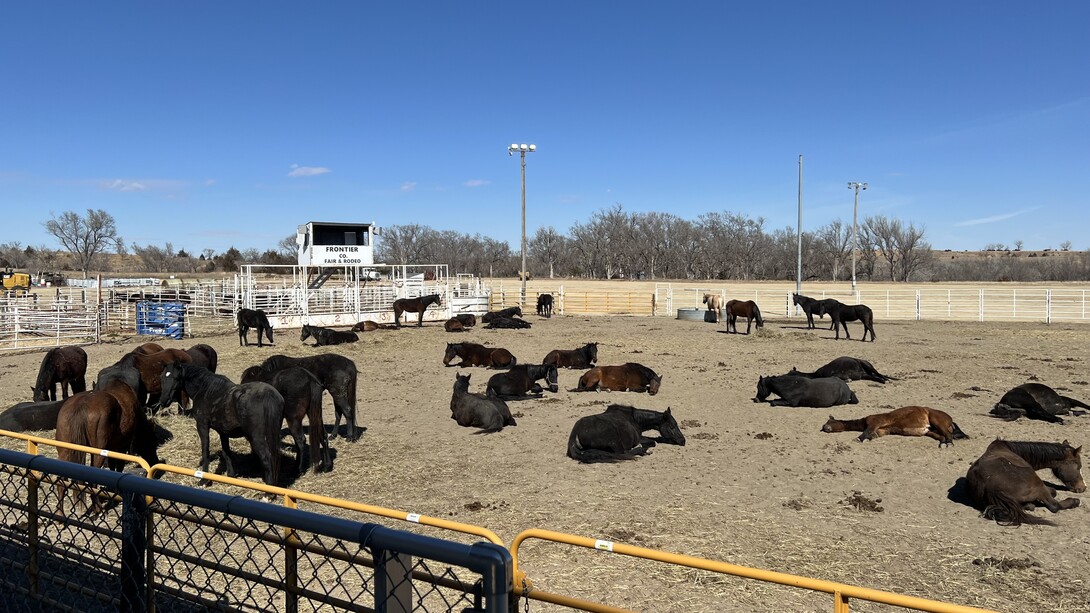
The dean's office associate, Victoria Grunden, shared her harrowing story that will be told for generations. As fire advanced toward her family’s operation, the immediate concern became the safety of 80 horses. With little time and rapidly changing conditions, the task of moving that many animals was overwhelming. Through quick coordination and the rapid spread of information, help arrived. Students and community members showed up with trailers, loading horses and moving them to safety in a coordinated effort that unfolded under pressure. In the aftermath, Grunden shared both relief and gratitude—for the hands that helped, the horses that were saved, and a community that responded without hesitation when it mattered most.
Moments like these often bring clarity. While agriculture is frequently taught through systems of production, management, and efficiency, those concepts take on new meaning under pressure. In conditions shaped by wind and fire, priorities narrow to what matters most: protecting what can be saved, helping where it is needed, and staying until the work is done. Students who have spent months studying grazing and livestock systems now see firsthand both the fragility and resilience of those systems, as well as the strength of the communities that support them.
Leadership, in this context, is not defined by titles or direction, but by presence. It is found in those who show up, remain through long hours, and do what is needed without seeking recognition. One faculty member described the past several days as a “whirlwind,” noting that even small acts, such as delivering supplies, carried significance.
This all comes during National Ag Week, a time traditionally set aside to celebrate agriculture and its contributions. This year, however, the tone feels different. In a week marked by fire and uncertainty, the prevailing message is one of gratitude. Gratitude for firefighters—both local and those who traveled from beyond Nebraska—who continue to work tirelessly. Gratitude for those moving livestock in difficult conditions, for those delivering supplies and offering support, and for those who remain connected through communication and coordination. Agriculture, in places like this, is not abstract; it is the land, the livestock, and the people who care for both, especially when they are at risk.
The fires are not fully contained, and conditions remain perilous with extreme heat in the days ahead. For the students of NCTA, the experience will not be easily forgotten. Not simply because of the scale of the fire, but because of what it revealed—about responsibility, about community, and about the role they already play within it.
In the midst of it all, one truth stands clear: it takes everyone.